
By Daniela Padilla, Strategic Partnerships & Fundraising Officer, Street Child Spain
When women have the opportunity to build a secure livelihood, children have a better chance to learn, grow and shape their own futures.
Education has the power to transform lives. It opens doors, breaks cycles of poverty and gives children the opportunity to shape their own futures. Yet, for millions of children around the world, going to school is still far from guaranteed.
Conflict, displacement and poverty force families to make impossible choices. When household income is not enough to cover basic needs, education is often one of the first things children have to give up. For girls, these barriers can be even greater, with gender discrimination, restrictive social norms and domestic responsibilities further limiting their opportunities.
But ensuring that children can go to school is not only about providing access to classrooms. It is also about addressing the challenges families face every day and creating the conditions that allow children to stay in education.
This is where Street Child comes in.
Local Action. Global Impact
Founded in 2008, Street Child works across 20+ countries in Africa, Asia, the Middle East and Europe, helping children in vulnerable communities access quality education, particularly where existing support is limited. Based in Barcelona since 2017, Street Child Spain is part of this international network, connecting local people, businesses and organisations through a shared mission: creating better educational opportunities for children around the world.
Because lasting change does not happen in isolation. It happens when communities are empowered to participate, take ownership and work together towards a shared goal.
But how does Street Child turn this commitment into meaningful, lasting change for families?
One of its flagship programmes offers a powerful answer: Family Business for Education (FBE). And perhaps the best way to understand what this means in practice is through the story of one mother.
One mother's business. Five children back in school.
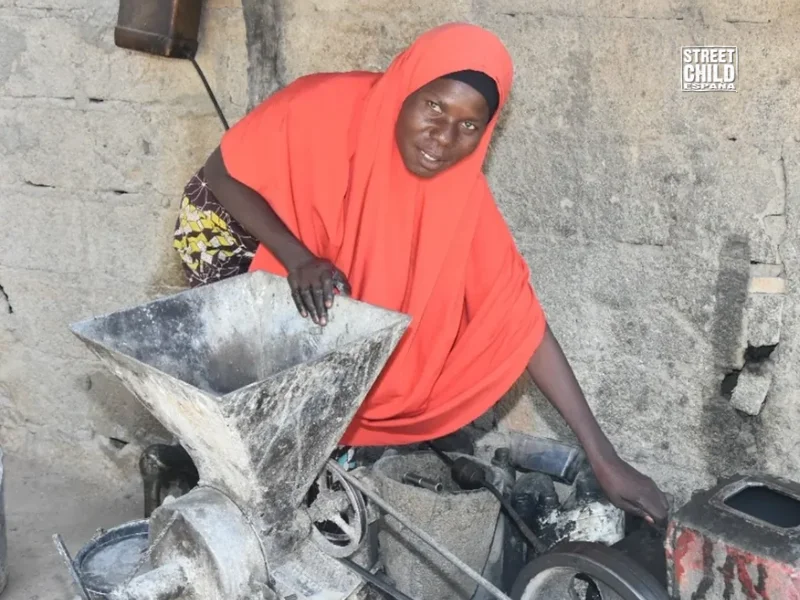
Aisha* was a mother of six living in Borno State, Nigeria. Before conflict forced her family to flee their home, she earned a living as a farmer. Displacement changed everything. In a new community on the outskirts of Maiduguri, she lost her income and struggled to provide for her children.
With no other option, Aisha borrowed money to buy small goods for her children to sell on the streets. The family needed every naira they could earn, and all six children had to leave school.
Then Aisha joined Street Child's Family Business for Education programme.
Through tailored business training and a start-up grant, she was able to invest in a grinding machine and establish a small business that met a real need in her community. What began as a way to earn an income quickly grew into a sustainable source of livelihood.
Her business generated around 3,000 naira per week. With this income, Aisha began sending her children back to school. Three enrolled in a temporary learning centre, and two more subsequently entered formal education.
Today, five of Aisha's six children are back in school, and she is saving for their school fees and future needs.
“Every morning, my children take what they need for lunch. I also use it to buy their socks, sandals, and writing materials. I've even started saving for their school fees and future needs.”
For Aisha, a small business became much more than a source of income. It meant being able to provide for her family, make decisions about their future and give her children back an opportunity they had lost.
Her story captures the idea at the heart of Family Business for Education: when families become more economically secure, children have a better chance of accessing and remaining in education.
*Name changed for safeguarding purposes.
Beyond financial support: Addressing the roots of educational inequality
Aisha's story is not an isolated example. It reflects a wider reality: children's access to education is closely connected to the economic and social circumstances of their families.
This is particularly important for women and girls. Women continue to face disproportionate economic disadvantages, while girls in vulnerable communities are more likely to experience barriers linked to early marriage, domestic responsibilities and restrictive gender norms.
Street Child recognises that supporting children to access and remain in education also means addressing the circumstances that shape their everyday lives.
Through its Family Business for Education (FBE) model, Street Child works with entire families, focusing particularly on caregivers, around 80% of whom are women. Participants receive start-up grants and tailored training in business planning, savings and financial management. The programme also includes positive parenting sessions that encourage families to reflect on gender roles, family dynamics and the importance of education.
The objective goes beyond helping families generate income. It is about strengthening women's economic independence, increasing their influence in household decisions and creating an environment where children, particularly girls, can stay in school.
And the impact goes beyond individual success stories:
- 54,000+ families supported through FBE.
- 90% of supported businesses survive for at least one year.
- 86% of children remain in education for two years after the support ends.
These results demonstrate why sustainable educational change requires more than short-term assistance. It requires investing in families, strengthening livelihoods and creating opportunities that last.
When a community comes together, change becomes possible
The challenges facing children and families around the world are complex, but meaningful change can begin with something as simple as bringing people together around a shared purpose.
This is where the PWN Barcelona community plays an important role.
Professional Women's Network brings together women from different backgrounds, industries and professional experiences, creating opportunities for connection, collaboration and collective action. These same strengths can also help advance causes that create opportunities for others.
By connecting professional networks with initiatives such as Street Child's Family Business for Education, we can help raise awareness, mobilise support and contribute to a future in which more families have the means to keep their children in school.
Aisha's story reminds us that empowering one woman can have an impact that reaches far beyond her own business. It can change the opportunities available to her children and help shape the future of an entire family.
Because when women have the opportunity to thrive, children have a better chance to learn, grow and build their own futures.
Discover Street Child's work and find out how you can be part of this initiative.
Play for Purpose on 28 November
On Saturday 28 November 2026, PWN Barcelona, Padel & Coffee Barcelona and Street Child Spain are coming together at Nick Club Pàdel Barcelona to raise funds for Street Child. Join us on court, come along as a supporter, or donate if you can’t make it.
Photo courtesy of Street Child Spain.