
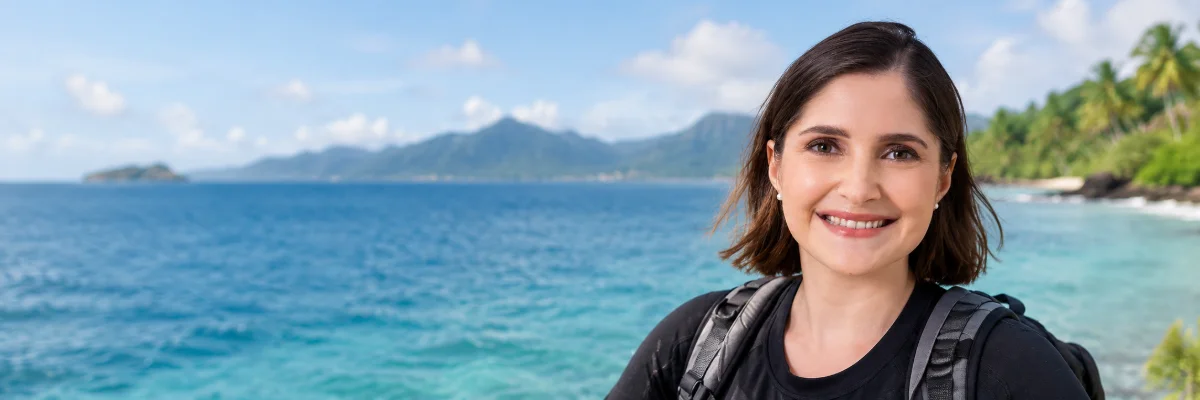
From LNG Carriers to an 80-Kilometre Expedition
PWN Norway member Kasia Sienkiewicz on leadership, women in the maritime industry, and supporting women affected by climate change
This interview has been edited for length and clarity.
On a typical day, Kasia’s role as Superintendent and Senior Operations Manager in the marine industry at BW LNG involves overseeing safety, ship maintenance, and budgeting. When circumstances take a more serious turn, she might be responding to a fire, a loss of propulsion, or even a pirate attack.
Now, Kasia is preparing for a very different kind of challenge: an 80-kilometer expedition through the mountains of Japan. As part of the all-women Her Planet Earth team, she is raising funds to support women seaweed farmers in Fiji whose livelihoods are increasingly affected by climate change.
We spoke with Kasia about her international career, her experience as a woman in the maritime industry, and why she decided to step outside her everyday life and take on this expedition.
Could you begin by telling us a little about yourself and what brought you to Norway?
I am originally from Poland, and I have lived in several different countries. I came to Norway about 14 or 15 years ago while studying drilling engineering. I had the opportunity to complete a double master’s curriculum in Stavanger, so I moved there to finish my studies.
That was also where I met my husband. We later lived in Denmark and Singapore, and after spending nine or ten years in those two countries, we decided that moving back to Norway would be a good next step.
I took a little break from my career to learn the language and become more familiar with Norwegian society. I then found a job and started building my life here.
You are now a Superintendent and Senior Operations Manager at BW LNG. What does your role involve?
My responsibility is to ensure the vessel sails safely, follows all international and local regulations, that maintenance is completed on time. I collaborate with both internal and external stakeholders, and the senior management team on board, together, we develop short- and long-term maintenance plans.
I also manage the vessel’s budget. We plan and negotiate everything we purchase or repair, along with other financial aspects of operating the vessel. If something happens during day-to-day operations, I'm responsible for helping tackle the problem and determine how to solve it.
How quickly can an ordinary day turn into a high-pressure situation?
It comes in waves. It can be quiet and feel like normal business, but unexpected situations can arise, including a fire on board, a loss of propulsion, or even a pirate attack. The role can move from steady day-to-day reporting and check-ups to quite an intense emergency situation.
How have your international experiences shaped the way you work?
Working in maritime definitely provides international exposure. When you work with vendors or seafarers, you need to understand their backgrounds, where they are coming from, how they communicate, and the factors that affect their actions and understanding.
Living in Scandinavia and the Far East opened my eyes to how people communicate, negotiate, and build business relationships.
Relationships matter most when a serious problem arises and you need help. It can be useful to turn to someone who has faced the same problem or can guide you in the right direction.
Being mindful of the diversity in each of us—and working with different nationalities, religions, and genders—adds another layer to every challenge. It is a learning experience every day.
Maritime has traditionally been a male-dominated industry. Have you seen that change during your career?
It is changing. The industry is adapting its standards to become more welcoming to women and to retain women in the maritime sector. Take something as simple as a boiler suit. Women need to take everything off to use the restroom, while men can simply pull down the zipper.
There are also safety considerations; boiler suits can be too large for someone of my height and size, and that can actually be unsafe. Tools and other equipment can present similar challenges.
However, awareness and education are improving. Having women both on board vessels and in office-based roles brings many benefits. Women contribute different points of view and challenge the status quo.
You’re about to undertake an 80-kilometer hike through Japan with Her Planet Earth. How did you first discover the organization, and what inspired you to join the expedition?
When I was living in Singapore, I was part of an organization called PrimeTime, which brings women together to support and empower one another. I first heard about Her Planet Earth when its founder, Christine Amour-Levar, spoke at one of our events. I found her story incredibly inspiring.
Christine is a mother of four who had built a successful international career in finance. But when she returned to the Philippines, where she grew up, she saw how many children and teenagers were living in communities facing real hardship. She was particularly struck by the fact that many women and girls simply did not have the same starting point or opportunities as others.
That thinking led her to create Her Planet Earth where all-women teams undertake expeditions. Each one is designed around a distinctive challenge. Previous expeditions have included cycling across Greenland during winter, traveling through the desert in Iran, cycling through the mountains of Sri Lanka and hiking through remote areas. We cover our own travel costs, and raise money and awareness for projects supporting women and their communities.
The women also meet local communities and Indigenous groups to learn firsthand what is happening in those places. They also collaborate with local guides and tour agencies, which helps support the communities they visit.
What made you decide to take part yourself?
Hearing Christina’s story really inspired me. She is a mother of four, runs her own business, works as an adviser and investor, has two organisations, plans several expeditions each year, and has also written a book.
I really look up to her. I thought, ‘I want to go with her, and I would like to join and do something extra for the cause beyond my daily life.’ Since becoming a mum, I have also wanted to get back into shape, become more active, get outside, and do something different.
Japan is a fantastic place to discover places beyond the large cities. When I saw that Christina was assembling a team, I thought it would be wonderful to join, begin fundraising, and see what I could do to support the cause.
The expedition takes place in Japan, but the funds you raise will support women seaweed farmers in Fiji. What connects the two?
Both Japan and Fiji are Pacific nations that are heavily affected by typhoons and the changing climate. Our 80-kilometre expedition will take us through the mountains outside Kyoto and towards the Sea of Japan, but the money we raise through Her Planet Earth will support a Conservation International project in Fiji.
Rising ocean temperatures and increasingly severe weather are damaging Fiji’s seaweed and mangrove ecosystems. This directly affects coastal communities, including women who depend on seaweed farming for their income.
The project is not simply about giving people money. It provides women seaweed farmers with tools, education and financial support while helping to restore mangrove areas. The aim is to develop sustainable ways of farming seaweed and help the women build reliable, long-term livelihoods despite the environmental pressures they face.
The project began following a typhoon in 2021 and is still continuing. Christine and several other women travelled to Fiji in July to see the work firsthand, and we have also spoken with the project manager from Conservation International about the progress being made, particularly with mangrove replanting. It is reassuring to know exactly what we are raising money for and the impact it is having.
What are you expecting the 80-kilometer expedition to be like?
I wanted to do something beyond my everyday life—to be part of something bigger and push myself both physically and mentally.
We will begin outside Kyoto, travelling through forests and climbing into the mountains before descending towards the Sea of Japan. The route follows an ancient trading path, and the weather may add another element of uncertainty.
It is not a race, and the aim is not to complete the route as quickly as possible. We will travel as a group, support one another, observe the natural environment and learn from the local communities we meet along the way.
We will also stay in locally run accommodation and small guest houses, helping us undertake the expedition in a way that is as sustainable as possible. I expect it to be challenging, but also physically and mentally rewarding.
Some members of the expedition will also meet Japan’s traditional female free divers. Can you tell us about that?
I am not personally joining that part because I have limited time away from work, but five or six team members will meet a local group of traditional Japanese female divers before the expedition.
These women live off the resources of the sea and harvest different products. The expedition participants will dive with them and learn how they work, how they earn an income, and how their traditional practices operate.
It is not part of the Conservation International project in Fiji, but it is an opportunity to understand the lives and work of a local group of female divers in Japan.
There are groups of women in Japan, the Philippines, and other parts of Asia who dive without breathing equipment to collect resources from the sea, including pearls and seaweed.
Their knowledge is remarkable. They know where to go, when to dive, and when the different seasons occur. Many of Japan’s traditional female free divers continue working into their 60s and 70s, carrying with them generations of knowledge about the sea, the seasons and sustainable harvesting.
What do you hope the lasting impact of the expedition will be for you personally?
I am thinking about what I will learn from the other women. We come from different backgrounds, work in different industries and are at different stages of life, so I want to learn from them and their stories.
I also want to push my limits. When things become uncomfortable, I want to keep going and make it to the end.
I hope to learn about Japan and gain insight into its culture, religion and customs from a more authentic perspective, rather than experiencing it only as a tourist.
I want to return with great memories and inspiration that I can apply to my daily life. Maybe I will develop more patience. Maybe I will discover that some limitations are in my head rather than in my body. It may also give me food for thought about what else I can do and whether there is something I can bring back to Norway.
I also hope to give my little son something to be proud of. Even though I will be away for some time, I am doing something for myself, and I will be able to share those stories with him.
How can PWN Norway members support you and the project?
Her Planet Earth has a shared fundraising page for the Fiji expedition, and each expedition member also has an individual donation link.
I opened a donation box in Vipps to make it easier for people in Norway to contribute without dealing with currency conversion. All the money donated through Vipps is transferred directly through the official fundraising link.
The funds go to Conservation International to support the project and the women involved. We greatly appreciate any contribution, and every donation helps!